
What Is Lyophilized? Definition and What Research Reports
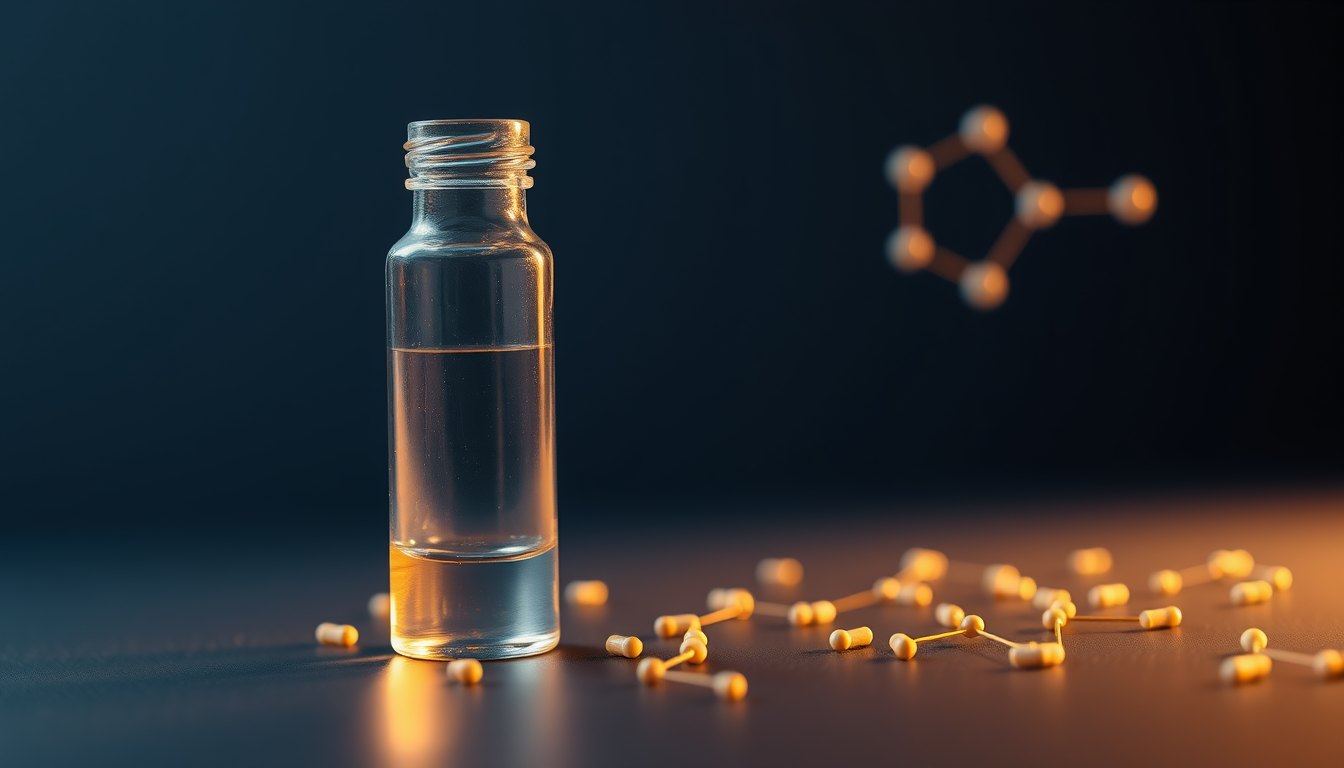
Lyophilized means freeze-dried. Material is frozen, then most of its water is removed under vacuum by sublimation, leaving a dry, porous solid called a cake that is later dissolved again in a liquid. In pharmaceutical science the term describes a manufacturing step used to stabilise fragile molecules — peptides, proteins, liposomes, viral vectors, cells and extracellular vesicles — for storage and transport. Published studies have examined residual moisture measurement, reconstitution behaviour, and whether freeze-dried preparations retain activity. This page is definitional and educational only.
The plain definition
Lyophilized (pronounced lie-OFF-ill-ized) simply means freeze-dried. A liquid preparation is frozen solid, then placed under a strong vacuum so that the frozen water turns straight from ice into vapour without ever melting. What remains is a dry, lightweight, often fluffy or crumbly solid — commonly called a cake or a plug — sitting in the bottom of a sealed vial. Because almost all of the water is gone, the chemical reactions that normally spoil a solution are slowed dramatically, so the material can be stored for far longer than the original liquid. Later, a liquid is added back to the vial to dissolve the solid, a step called reconstitution.
The technical definition
In pharmaceutical and biochemical terms, lyophilization is a low-temperature dehydration process with three recognised stages:
- Freezing. The solution is cooled until the water forms ice crystals and the dissolved solids concentrate between them. The freezing profile determines the pore structure of the final cake.
- Primary drying (sublimation). Pressure is reduced and a small amount of heat is applied so the ice sublimes directly to vapour, which is captured on a condenser. This removes the bulk of the water.
- Secondary drying (desorption). Water molecules still bound to the solid matrix are driven off at a slightly higher temperature, lowering residual moisture to the target specification.
Formulations intended for freeze-drying usually contain more than the active molecule. Bulking agents (such as mannitol) give the cake physical structure; cryoprotectants and lyoprotectants (such as sucrose or trehalose) sit between fragile molecules and replace the hydrogen bonds that water normally provides; buffers control pH. Collectively these are excipients. The finished vial is typically stoppered under vacuum or an inert gas and sealed, which is why appearance, headspace and moisture are all quality attributes rather than cosmetic details.
How the term is used in peptide research
Peptides are chains of amino acids, and in water they are vulnerable to hydrolysis, oxidation, deamidation and aggregation. Removing the water addresses several of these routes at once, which is why research-grade and pharmaceutical peptides are frequently supplied as a lyophilized powder in a sealed vial rather than as a ready-made solution. In laboratory literature and in product documentation, "lyophilized peptide" therefore describes a physical state and a manufacturing history — nothing more. It does not describe purity, identity, potency, sterility or regulatory status. Many peptide materials circulating outside approved medicines are labelled research use only (RUO), a regulatory designation meaning the material has not been evaluated or authorised for human or veterinary administration; that designation is independent of whether the contents are lyophilized.
Where the term is misused
- As a quality claim. Freeze-drying is a process step. A poorly characterised peptide is not made purer by being lyophilized.
- As a synonym for "sterile". Lyophilization is a drying process, not a sterilisation process. Sterility, where it exists, comes from aseptic processing or filtration upstream.
- Confused with air-drying or spray-drying. Those are different dehydration methods with different thermal stress and different solid-state outcomes.
- Cake appearance read as potency. Cakes can be dense, fluffy, shrunken or partly collapsed for formulation and cycle reasons. Appearance is a manufacturing quality attribute, not a measure of biological activity.
- Assuming indefinite stability. Published work on freeze-dried products consistently treats residual moisture, container closure and storage temperature as variables that still have to be measured.
Doing the math on a vial? The PeptideU app does reconstitution, units and dilution for you.
Try it freeRelated terms
| Term | Meaning |
|---|---|
| Freeze-dried | Everyday synonym for lyophilized |
| Sublimation | Ice converting directly to vapour, the core of primary drying |
| Cake | The porous dry solid left in the vial after the cycle |
| Reconstitution | Adding a liquid to dissolve the cake back into solution |
| Residual moisture | Water remaining in the cake after drying; a routine release test |
| Lyoprotectant | Excipient such as sucrose or trehalose that stabilises molecules during drying |
| Collapse | Loss of cake structure when drying occurs above the formulation's critical temperature |
What the published literature reports
Measuring what is left behind
Because residual water drives degradation, its measurement is a recurring theme. Researchers described a noninvasive approach to moisture determination in lyophilized drug product using a near-infrared spectrometer together with a headspace moisture analyser, evaluating these methods as alternatives to destructive testing of individual vials (PMID 36395899). The study framed moisture content as a measurable product attribute rather than an assumption.
Reconstitution and integrity
A second recurring question is whether a molecule survives the drying and dissolving cycle intact. In one report, researchers examined the pharmaceutical integrity of lyophilized methemoglobin–albumin clusters after reconstitution, assessing whether the reconstituted material retained its expected characteristics (PMID 37396217). Work on complex carriers has followed the same logic: a lyophilized sterically stabilised liposome containing docetaxel was evaluated in vitro and in vivo, with the freeze-dried formulation compared against its liquid counterpart (PMID 27031365).
Biologics, vectors and vesicles
Freeze-drying has been studied as a route to less demanding storage for biological materials. Investigators reported that lyophilization was an effective tool for developing AAV8 gene therapy products suitable for refrigerated storage (PMID 37914106). In the extracellular vesicle field, one group examined lyophilized mesenchymal stromal cell-derived extracellular vesicles and their therapeutic function in neuroinflammatory models (PMID 41051108), and a separate mechanistic study assessed the functionality of lyophilized osteoinductive extracellular vesicles (PMID 39502498). Cell-derived products have been handled similarly: a canine lyophilized platelet preparation produced a dose-dependent effect in an in vitro hemodilution model, as the study reported (PMID 36932415).
Beyond injectables
The term also appears well outside vial-and-syringe contexts. Researchers prepared celecoxib lyophilized orally disintegrating tablets and evaluated their bioavailability (PMID 40436212); an ophthalmology group described lyophilized autologous serum eyedrops in an experimental and comparative study (PMID 32006480); food scientists measured the viability of lyophilized probiotic lactic acid bacteria incorporated into potato chips alongside effects on oil oxidation (PMID 32380678); and analytical chemists used lyophilized cells of the red alga Galdieria sulphuraria to study reversible adsorption of iridium (PMID 37179988). Freeze-dried presentations also reach large-scale clinical use: one analysis reviewed records covering 30,097 cases of a lyophilized Xuesaitong injection in real-world practice (PMID 33350278).
Tracking research? Log entries with dates, lots and notes — records, never plans.
Get the appLyophilized Preparations and Safety Signals: What Studies Report
The verified literature summarised here is largely formulation and process science, not comparative safety research, so it does not establish an adverse-event profile for lyophilized materials as a category. The large real-world analysis of a lyophilized injection was descriptive of routine use patterns in a sizeable case series (PMID 33350278), and the process-focused papers assessed physical and functional attributes such as moisture, integrity after reconstitution and retained function (PMID 36395899, PMID 37396217). Safety of any specific freeze-dried product depends on that product's identity, formulation, sterility and approval status, not on the drying step alone.
Limits of the term
"Lyophilized" answers one question: how the water was removed. It says nothing about what the vial contains, how pure it is, whether it was made under controlled conditions, or whether any regulator has evaluated it. Much of the published work above exists precisely because freeze-drying outcomes vary with formulation and cycle design, and therefore have to be tested case by case.
This page is for educational purposes only and is not medical advice; consult a licensed physician about any health decision. Nothing here describes preparation, administration or use of any substance in humans.
Want the full course? Every compound, evidence-graded and cited, inside PeptideU.
Start learning freeReferences
- Dose-dependent effect of canine lyophilized platelet on an in vitro hemodilution model (BMC Veterinary Research, 2023)
- A lyophilized sterically stabilized liposome-containing docetaxel: in vitro and in vivo evaluation (Journal of Liposome Research, 2017)
- Pharmaceutical Integrity of Lyophilized Methemoglobin-Albumin Clusters after Reconstitution (ACS Omega, 2023)
- Freeze-Dried, Not Frozen: Lyophilized Mesenchymal Stromal Cell-Derived Extracellular Vesicles and Therapeutic Function in Neuroinflammatory Models (Journal of the American College of Surgeons, 2026)
- Preparation and evaluation of celecoxib lyophilized orally disintegrating tablets with high bioavailability (European Journal of Pharmaceutics and Biopharmaceutics, 2025)
- Lyophilized Probiotic Lactic Acid Bacteria Viability in Potato Chips and Its Impact on Oil Oxidation (Foods, 2020)
- Analysis of Injection of Xuesaitong (lyophilized) in 30097 cases in real world (China Journal of Chinese Materia Medica, 2020)
- Lyophilized Autologous Serum Eyedrops: Experimental and Comparative Study (American Journal of Ophthalmology, 2020)
- Noninvasive Moisture Detection in Lyophilized Drug Product Using NIR Spectrometer and Headspace Moisture Analyzer (Journal of Pharmaceutical Sciences, 2023)
- Functionality of lyophilized osteoinductive EVs: a mechanistic study (Frontiers in Bioengineering and Biotechnology, 2024)
- Reversible adsorption of iridium in lyophilized cells of the unicellular red alga Galdieria sulphuraria (RSC Advances, 2023)
- Lyophilization as an effective tool to develop AAV8 gene therapy products for refrigerated storage (International Journal of Pharmaceutics, 2023)
Frequently asked questions
What does "lyophilized" mean in simple terms?▾
It means freeze-dried. The material is frozen, then held under vacuum so the ice turns directly into vapour, leaving a dry porous solid called a cake. Removing water slows the chemical reactions that degrade a solution. Studies of freeze-dried products routinely measure how much water is left behind, since residual moisture is treated as a quality attribute (PMID 36395899).
Is "lyophilized" the same as "freeze-dried"?▾
Yes. The two words describe the same process and are used interchangeably in the literature; one paper on mesenchymal stromal cell-derived extracellular vesicles even used the phrase "freeze-dried, not frozen" in its title while studying lyophilized vesicles (PMID 41051108). "Lyophilized" is the more common term in pharmaceutical manufacturing and analytical writing, "freeze-dried" in food and everyday contexts.
What is a lyophilized peptide?▾
It is a peptide supplied as a dry freeze-dried powder in a sealed vial rather than as a solution. The term describes the physical state and manufacturing history only — not purity, identity, potency, sterility or regulatory status. Many such materials carry a research-use-only designation, meaning they have not been evaluated or authorised for human administration. That designation is separate from whether the contents were lyophilized.
Why are peptides and biologics freeze-dried at all?▾
Because water drives hydrolysis, oxidation and aggregation, and because dry material can often be stored under less demanding conditions. Researchers reported that lyophilization was an effective tool for developing AAV8 gene therapy products suitable for refrigerated storage (PMID 37914106), and other work has evaluated whether freeze-dried extracellular vesicles retain function in laboratory models (PMID 39502498).
Does lyophilization mean a product is sterile?▾
No. Lyophilization is a dehydration process, not a sterilisation step. Sterility, when present, comes from aseptic processing or filtration earlier in manufacture, along with container-closure integrity. Published freeze-drying research focuses on attributes such as residual moisture and whether material stays intact after reconstitution (PMID 37396217), which are separate questions from microbiological control.
What does reconstitution mean?▾
Reconstitution is the step where a liquid is added to a lyophilized cake so it dissolves back into solution. Whether a molecule survives that cycle unchanged is an active research question: one study assessed the pharmaceutical integrity of lyophilized methemoglobin-albumin clusters after reconstitution (PMID 37396217). This page describes the concept only and gives no instructions for handling any material.
Are lyophilized products only injectables?▾
No. The term appears across many formats. Researchers prepared celecoxib lyophilized orally disintegrating tablets and evaluated their bioavailability (PMID 40436212), an ophthalmology group studied lyophilized autologous serum eyedrops (PMID 32006480), and food scientists measured lyophilized probiotic bacteria viability in potato chips along with effects on oil oxidation (PMID 32380678).
Track it. Calculate it. Actually understand it.
References
This page summarises published research for education — it is not medical advice, and nothing here is a recommendation to use, purchase, or dose any substance. Study parameters described are what researchers reported, not instructions. Consult a qualified clinician before any health decision.